Part Three of Lesson One: Learning French – Asking for Help and Expressing Understanding
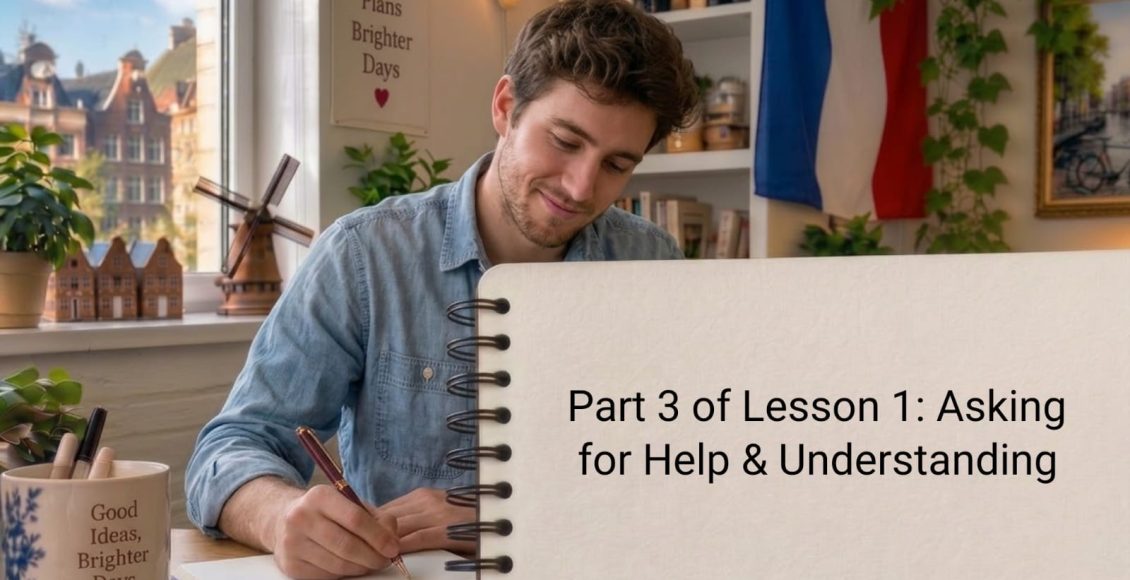
Part Three of Lesson One: Learning French – Asking for Help and Expressing Understanding
Together, let us continue the journey of developing your level in French through this part that complements the greetings and introductions lesson, in which we move to a deeper and more detailed stage in building daily conversations. This lesson aims to give you the basic language tools that enable you to break the barrier of fear, and start making real and effective introductions in a smooth and direct style that suits various life and social situations.
This part focuses on mastering French learning skills related to asking for help, clarifying how well you understand the conversation, directing the other person to speak slowly when needed, in addition to expressing your basic desires and daily needs in a polite manner. These expressions and vocabulary are essential and indispensable for anyone preparing to travel abroad to move around and settle, or planning to study abroad and communicate with multicultural academic environments.
This lesson includes a new set of common and most widely used expressions in personal introduction conversations in French, which range between basic questions and their model answers. Each phrase has been supported with a direct audio listening feature to ensure practice of correct pronunciation from its source, and to acquire sound articulation that gives you full confidence while speaking with others in French.
French Course for Daily Communication
Asking for help and expressing understanding in everyday conversations.
🤝 Pouvez-vous m’aider ?
Can you help me?
🤷♂️ Je ne comprends pas.
I don’t understand.
🐢 Pouvez-vous parler plus lentement ?
Can you speak more slowly?
❓ Qu’est-ce que ça veut dire ?
What does this mean?
☕ Je voudrais un café.
I would like a coffee.
🔁 Pouvez-vous répéter, s’il vous plaît ?
Can you repeat that, please?
✍️ Comment ça s’écrit ?
How is it written?
🤷♀️ Je ne sais pas.
I don’t know.
🙏 Excusez-moi.
I’m sorry / Excuse me.
👌 Ce n’est pas grave !
No problem!
Now, after you’ve mastered these phrases and listened to their correct pronunciation, it’s time for the challenge! Here’s a quick quiz to confirm your understanding and fix the words in your memory. Test yourself now with confidence, and don’t move on to the next lesson until you’re sure you’re fully ready!
📝 Test what you’ve learned
1. How do you ask someone for help politely in French?
2. What is the correct meaning of the phrase: “Pouvez-vous répéter, s’il vous plaît ?”
3. When you want to know how a certain word is written or spelled in French, you say:
4. What is the appropriate phrase to apologize directly?
5. What is the appropriate response when someone apologizes to you?
Now that you’ve mastered this set of phrases and tested how well you’ve understood them, you’re fully ready to move on to the next step. In the next lesson, we’ll continue building your French vocabulary by opening up new horizons and learning more varied phrases, which will help you develop your conversation and communication skills with greater confidence and fluency in different everyday situations.