Part Two of Lesson One: Learning Dutch and Using It to Introduce Yourself and Your Profession
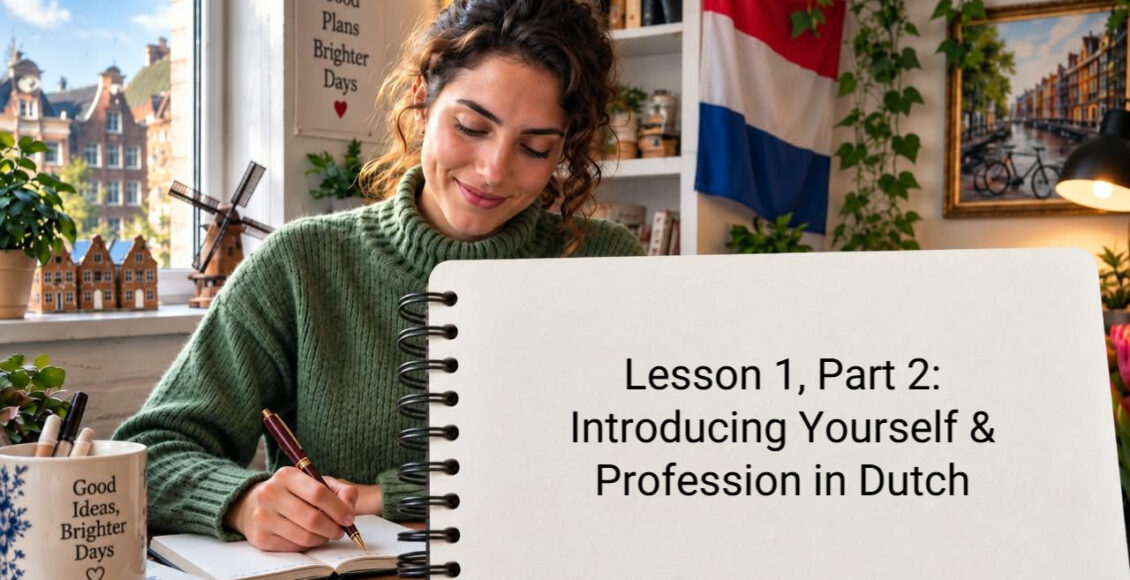
Part Two of Lesson One: Learning Dutch and Using It to Introduce Yourself and Your Profession
We continue together on your journey to develop your level in the Dutch language through this complementary part of the greetings and introductions lesson, in which we move to a deeper and more detailed stage in building daily conversations. This lesson aims to give you the essential linguistic tools that enable you to break the barrier of fear, and to start making real and effective introductions in a smooth and direct style that suits various life and social situations.
This part focuses on mastering the Dutch learning skills related to introducing yourself accurately, and speaking with confidence about your origins, your nationality, and the country you aspire to visit, in addition to explaining the nature of your work or field of study. These expressions and vocabulary are fundamental and indispensable for anyone preparing to travel abroad to move around and settle, or planning to study abroad and communicate with multicultural academic environments.
This lesson includes a new set of common and most widely used expressions in personal introduction conversations in Dutch, which vary between basic questions and their model answers. Each phrase has been supported with a direct audio listening feature to ensure training in correct pronunciation from its source, and to acquire sound articulation that gives you full confidence while speaking with others in Dutch.
Dutch Course for Daily Communication
The most important introduction and communication phrases in Dutch for beginners, with an explanation of usage and correct pronunciation.
🏙️ Waar woon je?
Where do you live?
🏠 Ik woon in Amsterdam.
I live in Amsterdam.
🎂 Hoe oud ben je?
How old are you?
🎈 Ik ben vijfentwintig jaar oud.
I am twenty-five years old.
💼 Wat doe je voor werk?
What do you do for work?
👨💻 Ik werk bij een bedrijf.
I work at a company.
🙂 Hoe gaat het met je?
How are you?
👍 Het gaat goed, dank je.
I am fine, thank you.
👋 Tot later.
See you later.
🚶 Tot ziens!
Goodbye!
Now after you have become familiar with the phrases and practiced their correct pronunciation, it is time for a quick quiz to make sure you have understood and to fix the information in your mind. Try to answer the following questions to test your skills and check your level before moving on to the next lesson!
📝 Test Your Knowledge
1. How do you ask someone in Dutch about where they live or reside?
2. What is the appropriate answer when someone asks you: “Hoe oud ben je?”
3. What is the correct meaning of the phrase: “Wat doe je voor werk?”
4. Which of these is used to ask how someone is doing in Dutch?
5. What is the translation of the phrase: “Tot later”?
After you have mastered this set of phrases and tested how well you have understood them, you are now fully ready to move on to the next step in the Dutch course for beginners. In the next lesson, we will continue together to expand your linguistic repertoire through new situations and more varied phrases to develop your conversation and communication skills fluently.